
The 2026 World Cup is set to be the largest in FIFA history, expanding to 48 nations and introducing a complex matrix of new group dynamics. For analytical sports bettors, this expansion creates an unprecedented volume of statistical noise. While traditional match-winner (1X2) markets will be flooded with public bias, specialized totals markets-specifically Both Teams to Score (BTTS)-present a far higher concentration of mathematical inefficiency.
To extract consistent long-term yield from BTTS markets, bettors must move past basic qualitative assumptions like "both teams have good strikers." Success requires a rigorous both teams to score betting strategy backed by probability distributions, historical tournament variance, and game-state tracking.
This comprehensive guide outlines the exact quantitative models needed to price World Cup 2026 BTTS markets and identifies the systemic discrepancies built into tournament structures.
Quick Guide: The BTTS Probability Blueprint
Before diving into the mathematical models, review the three fundamental mechanics that govern successful BTTS trading during elite international tournaments.
| Strategy Pillar | Analytical Focus | Primary Objective | Optimal Execution Window |
|---|---|---|---|
| The Poisson Model | Statistical Implied Probability | Identify discrepancies between bookmaker odds and math. | Pre-Match (24 Hours prior) |
| Phase Variance | Group vs. Knockout Dynamics | Account for tactical shifts (conservatism vs. urgency). | Tournament Milestone Splits |
| Game-State Drift | Live In-Play Trailing Triggers | Capitalize on high-variance late goals when favorites trail. | Live Betting (Minutes 60?85) |
Goal Mathematics: The Poisson Distribution Model
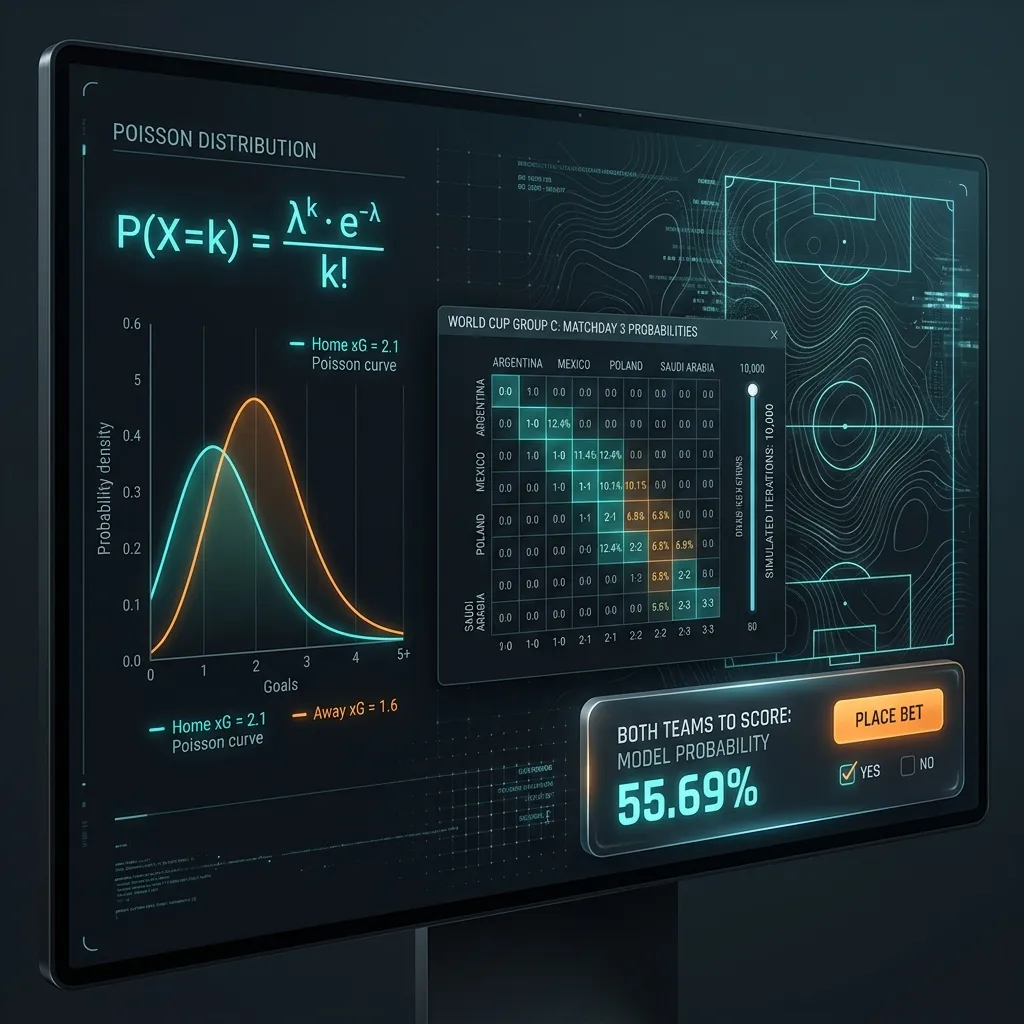
The cornerstone of any advanced both teams to score betting strategy is the Poisson Distribution. In football, we treat goal-scoring as a random, independent event occurring at a known average rate. By calculating the Expected Goals (xG) rate of two opposing sides, we can precisely derive the probability of a Both Teams Score: Yes outcome.
Step 1: Calculate Independent Probabilities
For the BTTS market to win, both teams must score at least 1 goal. Statistically, the most accurate path is to calculate the inverse event (either team keeping a clean sheet) and subtract from 100%.
The formula to determine the probability (P) of scoring exactly k goals with an average rate (?) is:
P(k; ?) = e^(-?) ? ?^k / k!
To find the probability of a clean sheet (k=0), the equation elegantly reduces to:
P(0; ?) = e^(-?)
Step 2: Combined BTTS Calculation
Consider a 2026 World Cup matchup between Team A (Expected Goals ?_A = 1.8) and Team B (Expected Goals ?_B = 1.1).
- Probability Team A keeps a clean sheet: e^(-1.8) ? 16.5% (They have 83.5% chance of scoring at least 1).
- Probability Team B keeps a clean sheet: e^(-1.1) ? 33.3% (They have 66.7% chance of scoring at least 1).
Assuming independence, we multiply the scoring probabilities together:
BTTS Probability = (1 - 0.165) ? (1 - 0.333) = 0.835 ? 0.667 = 55.69%
Step 3: Convert to Fair Decimal Odds
To find the fair market price, invert the probability:
Fair Decimal Odds = 1 / 0.5569 ? 1.79
If bookmakers are offering odds above 1.79 (e.g., 1.95), you have identified a Positive Expected Value (+EV) bet. You can leverage these edges using the offers catalogued in our Best World Cup 2026 Free Bets guide.
The "Tournament Phase Dissonance" Effect
One of the most dangerous mistakes in BTTS modelling is applying static assumptions across all stages of the tournament. The psychological and normative context shifts dramatically between phases.
1. Group Stage: The Underdog Lock
In Matchday 1 and 2, preserving goal difference and earning points is the only tactical driver. Traditional underdogs deploy deep, compact defensive blocks to grind out a 0-0 draw.
- •Mathematical Adjustment: We recommend reducing the calculated ? (xG) for the non-favorite by 10?15% in the opening group stage. Historical data consistently favours BTTS: No in these fixtures.
2. Knockout Stage: The Chaos Script
Once the tournament enters K.O. rounds (Round of 32 onward), the game theory inverts completely. If a team is trailing by one goal at the 75th minute, the incentive to "protect goal difference" evaporates entirely.
- •Tactical Shift: Coaches stack attackers, break defensive lines, and push center-backs forward. This "all-or-nothing" scenario exponentially inflates the probability of a dramatic equalizer or a clinical counter-seal.
- •Historical Data Point: At the 2022 Qatar World Cup, while the group stage returned a low 43.7% BTTS: Yes rate, the knockout stage surged to a commanding 62.5% BTTS: Yes.
Expansion Volatility: 48 Nations in Competition
The new expanded format introduces a novel ingredient: widening skill gaps.
The presence of debut nations and lower-ranked FIFA sides guarantees a substantial volume of lopsided matchups during the opening round.
How to Price Asymmetric BTTS Markets:
- •Beware of General Goals Over: Bookmakers will often post tight, over-vigged "Over 2.5 Goals" lines on power-vs-minnow matchups.
- •The BTTS: No Inefficiency: These games frequently result in 3-0 or 4-0 blowouts. As the general goal count inflates, bookmakers mistakenly extend the BTTS: Yes odds, opening massive +EV windows to back the clean sheet if the weaker side has a historical scoring conversion rate below 25% vs. Top 20 nations.
In-Play Operation: The 70-Minute Window
For live traders, the best both teams to score strategy in-play is to monitor physical and tempo metrics after passing the 70-minute mark.
At this late stage, muscle fatigue combined with fresh substitutions creates defensive holes. Look for scenarios meeting all of these parameters:
- Current Score: 1-0 or 0-1.
- Trailing Team xG Accumulation: The trailing team has accumulated at least 0.8 xG, confirming they are generating attack but suffering from variance.
- Pressure Index: Minimum 4 corners or 6 confirmed entries into the opposition box in the last 15 minutes.
When this ecosystem aligns, the real probability of a goal is drastically higher than the linear decay models used by traditional bookmaker algorithms. Securing odds above 3.00 (+200) in this window delivers disproportionately high returns relative to the actual mathematical risk.
Frequently Asked Questions
Does the BTTS market cover extra time at the World Cup?
No. Per the terms and conditions of the vast majority of licensed operators, the BTTS market settles strictly on the 90 minutes of regulation time plus stoppage time decreed by the referee. Goals scored in extra time or penalty shootouts have zero impact on BTTS bet settlement.
How does FIFA's expanded added time policy impact BTTS?
The FIFA directive to account for all stoppage time (implemented since 2022) regularly pushes matches to 100+ minutes of play. These additional minutes occur at a peak of athletic exhaustion, multiplying defensive errors and late penalties.
Is it profitable to back BTTS: No in World Cup finals?
Historically, the data supports this theory. High-magnitude finals impose maximum tactical respect, inducing ultra-conservative setups. Predictive models consistently reflect edges on defensive shutouts.
Editorial Opinion
Mastering the both teams to score betting strategy for the 2026 tournament demands silencing fan bias in favour of structured scientific data.
Leverage the power of the Poisson Distribution to build your own base odds, dial down goal expectation for group-stage defensive locks, and activate your live trading alerts for the tactical chaos of knockout stages.
Remember to have validated accounts at multiple licensed operators to always secure the best available market price, ensuring no theoretical profitability point is lost to avoidable commission.