
The 2026 FIFA World Cup will be the most structurally radical tournament in modern sports history. Expanding from 32 to 48 nations, the tournament will see the total number of matches skyrocket from 64 to a staggering 104 games. For sports investors, this massive increase in sample size completely alters the calculus of tournament-long totals and game-by-game world cup total goals prediction models.
Historically, the World Cup has exhibited distinct "eras" of scoring density, oscillating between extreme defensive consolidation and high-tempo, fatigue-driven goal gluts. By analyzing these macro historical trends and applying them to the new, untested format of 2026, analytical bettors can exploit massive inefficiencies in the Over/Under futures and pre-match betting pools.
This definitive guide audits historical goal data, models the impact of the expanded bracket, and delivers a data-backed forecasting blueprint for the Over/Under markets at the 2026 World Cup.
Quick Audit: The Historical Goals Arc (1998?2022)
Before projecting the future, we must benchmark the past. Since the introduction of the 32-team format in 1998, tournament scoring has followed a clear evolutionary arc.
| FIFA World Cup | Total Matches | Total Goals | Goal-Per-Game Average | Over 2.5 Goals % |
|---|---|---|---|---|
| Qatar 2022 | 64 | 172 | 2.69 (Modern Record) | 54.6% |
| Russia 2018 | 64 | 169 | 2.64 | 51.6% |
| Brazil 2014 | 64 | 171 | 2.67 | 53.1% |
| South Africa 2010 | 64 | 145 | 2.27 (Defensive Peak) | 40.6% |
| Germany 2006 | 64 | 147 | 2.30 | 43.7% |
| Korea/Japan 2002 | 64 | 161 | 2.52 | 46.8% |
| France 1998 | 64 | 171 | 2.67 | 53.1% |
The Analytical Finding: The Scoring Renaissance
Since 2014, the world cup goals per game average has stabilized in a high-scoring band of 2.64 to 2.69. This resurgence-following the ultra-conservative era of the mid-2000s-is driven by three structural factors:
- The institutionalization of VAR (generating higher penalty awards and conversions).
- Increased physical fatigue at the end of increasingly congested club seasons.
- High-press tactical systems deployed even by mid-tier nations.
Modelling the 2026 Expansion: The Multiplier Effect
The jump to 48 participants is not simply a linear increase in matches; it introduces systemic changes that alter the global goal expectation (?). To build a robust world cup over under betting model, we must isolate two opposing forces.
Force 1: Talent Dilution & Asymmetric Loading (Inflationary)
With 16 additional qualifying slots, the tournament will host a significant influx of debut or lower-calibre nations from the AFC, CAF, and CONCACAF confederations. Historically, matchups between established elite powers (UEFA/CONMEBOL) and these newcomers generate high goal variance.
- •The Blowout Phenomenon: In a 32-team format, group stages are tightly seeded. In 2026, we anticipate a significant increase in asymmetric matchups during the opening phase. Against a world-class attack operating against unaccustomed defenses, the mathematical probability of scorelines like 4-0 or 5-0 increases dramatically.
- •Betting Angle: Pre-match lines for these games will often sit at 2.75 or 3.0 total goals. On J1 matchups, backing Over 2.5 or 3.0 will carry substantial value as inexperienced defenses struggle to acclimate to elite-level pace.
Force 2: The "Best Third-Place" Conservative Trap (Deflationary)
Under the 2026 regulations, the top two teams from each of the 12 groups advance, accompanied by the 8 best third-place finishers. This fundamentally alters the tactical incentives in the final group matchday.
- •The Draw Pact: In groups where two teams already hold 3 or 4 points, a draw can mathematically guarantee both sides advance. Furthermore, third-place progression is determined primarily by Goal Difference. A team arriving at Matchday 3 with a neutral differential has zero incentive to attack aggressively and risk conceding.
- •Betting Angle: Matchday 3 is set to be a breeding ground for slow, tactically-closed matches. We forecast a dramatic statistical uptick in Under 2.5 and Under 1.5 results driven by this structural regulatory factor.
Mathematical Application: Poisson & Fair Price Calculation
Advanced bettors translate these macro concepts into empirical probabilities using distribution models. By deriving your combined Expected Goals (xG) for a 2026 match, you can immediately identify the theoretical "fair price" for the Over 2.5 market.
Step 1: Establish the Combined Mean (?)
Aggregate the offensive expectation of Team A against Team B's defensive goals conceded rate. Suppose for a group stage match you have determined an Expected Goals figure of ? = 2.8.
Step 2: Sum Under-Threshold Probabilities
Using the Poisson equation (P(k; ?) = e^(-?) ? ?^k / k!), we calculate the percentage probability of exactly 0, 1, or 2 goals:
- •P(0; 2.8) ? 6.08%
- •P(1; 2.8) ? 17.03%
- •P(2; 2.8) ? 23.84%
Total Under 2.5 probability = 6.08% + 17.03% + 23.84% = 46.95%.
Step 3: Derive the Over 2.5 Fair Price
Subtract the Under probability from 100% to find the Over 2.5 probability:
- •Over 2.5 Probability = 100% - 46.95% = 53.05%
- •Fair Decimal Odds = 1 / 0.5305 ? 1.88
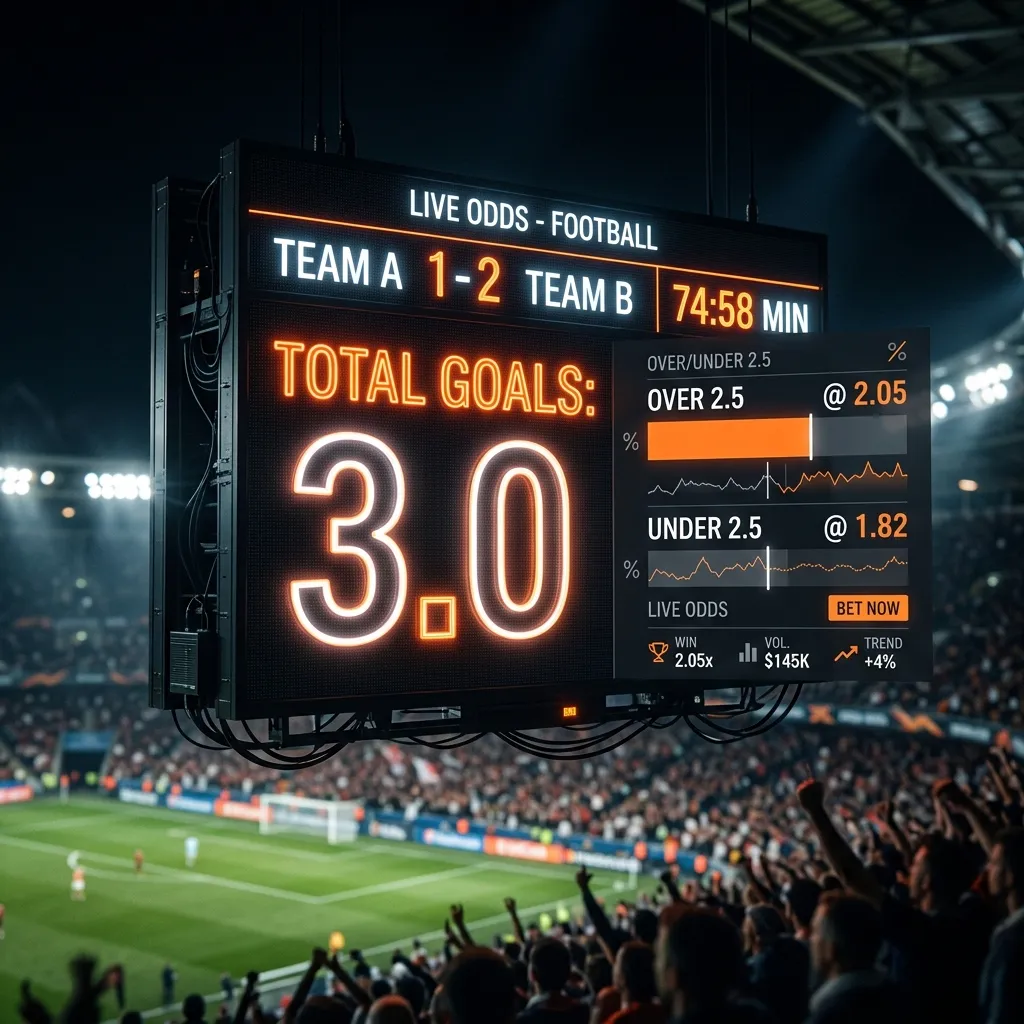
If a bookmaker is offering Over 2.5 at odds of 2.05, you have verified a Positive Expected Value (+EV) scenario. To squeeze your operating margin further, compare the active bonuses in our Best World Cup 2026 Free Bets ranking. For a deeper study on modelling combined team scoring, review our expert BTTS Betting Strategy Guide.
Live Trading: The 75th Minute Line Reset
Because international tournament matches carry immediate, binary consequences, in-play algorithms at traditional operators often react slowly in the final minutes of matches.
Analytical live traders should monitor "Next Goal" or additional Over markets between the 70th and 80th minute. Target knockout-round games meeting these tactical filters:
- Current Score Differential: Exactly 1 goal (1-0, 2-1, 3-2).
- Match Phase: Single-elimination knockout round (no second leg).
- Tactical Drift: The trailing team has introduced fresh attacking substitutes and is generating a high volume of corners or box entries in the final 10 minutes.
In these no-alternative scenarios, the losing side will dismantle all defensive structure from the 80th minute onward. This open field guarantees either a pressure-driven late equalizer or a clinical counter-seal against an exposed back line. Backing Over on this final window delivers inflated odds that are wholly disconnected from the actual mathematical risk.
Frequently Asked Questions
Do Over/Under bets include extra time at the World Cup?
No. As a general industry rule, the standard Over/Under Goals market settles strictly on the official 90 minutes of regulation time plus stoppage time. Any goals scored in extra time or penalty shootouts are not counted.
How will FIFA's extended added time policy impact goal totals?
The FIFA directive to account precisely for all stoppages-which pushed matches beyond 100 minutes at Qatar 2022-is expected to continue. These extra minutes occur at a peak of extreme physical fatigue and are highly fertile for goal-scoring, organically inflating tournament averages.
Will the introduction of a Round of 32 increase goal averages?
Statistically, yes. Adding an additional knockout round multiplies the volume of "high-stakes" matches where the offensive risk in the final stages of a game is maximized, creating conditions favorable for late goals.
Verdict & Editorial Prediction
Our definitive total goals prediction for 2026 anticipates a tournament of two statistical speeds.
We expect Matchday 1 and 2 group fixtures to aggressively lean toward Over 2.5, fueled by asymmetric matchups against debut nations. However, we anticipate a sharp correction toward Under on Matchday 3, when "best third-place" calculus incentivizes tactical hoarding.
We project the overall tournament goal average will close between 2.72 and 2.78 per match, establishing the highest benchmark in the history of modern football. Build your models, divorce yourself from public emotional bias, and diversify your positions across multiple licensed and regulated operators to secure your profitability in this historic expanded tournament.